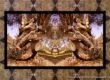


BYZANTINE ICON: “MADONNA OF TENDERNESS”
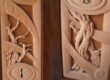
TECHNIQUE: Acrylic paint on a gessoed wood panel (multilayered, 1.8 cm thick). Carved solid wood frame, gessoed and covered in imitation gold leaf.
TOTAL DIMENSIONS : 65 cm X 38 cm
A GUIDE TO READING THE ICON
Madonna of Tenderness, also known as “Our Lady of Vladimir” or “Theotokos of Vladimir” (“Theotokos” is a Greek term meaning “Mother of God”).
At the top, the Greek letters MP (on the left) and OY (on the right) are the monogram for Meter Theou, “Mother of God”. The letters IC XC in the upper central area stand for “Iesus” and “Christos” respectively, while those on the Child’s halo (Ο Ω Ν) mean “The One Who Is.”
Mary holds the Child on her right arm, presses him close, and inclines her head until her cheek touches her Son’s. It is the depiction of a tender embrace, but the one who truly initiates the embrace is not the Mother, but the Son. It is the Christ Child who, by embracing His Mother, symbolizes His embrace of all humanity.
Three Syriac stars, two on her shoulders (one is covered by the Child) and one on her forehead, indicate the dogma of her virginity (before, during, and after childbirth).
The colors of the garments mirror the exact inverse of those in the icon of the Christ Pantocrator, who wears a red tunic symbolizing his divine nature, covered by a blue cloak signifying his humanity. Here, however, the Mother of God, as a descendant of Adam but divinized by grace, wears a blue garment (symbol of her human nature) covered by a crimson cloak (symbol of divine nature). The garment is the maphorion, the traditional dress of consecrated virgins.
The Child wears an ochre garment, a color that in iconographic tradition symbolizes belonging to the divine plane of creation.